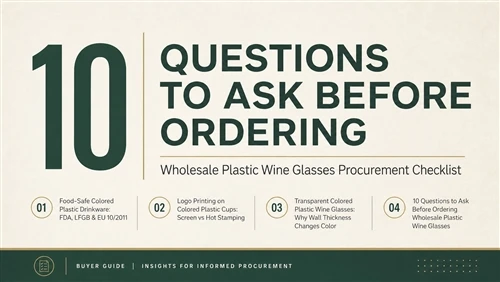
Logo Printing on Colored Plastic Cups: Screen Printing vs Hot Stamping
A custom color gives your plastic cups a look. A logo gives them a brand. But logo printing on colored plastic cups is not as simple as placing artwork on a clear glass. The base color changes how ink looks, and each decoration method has different strengths for durability, detail, and cost. This guide compares the main options so importers, event suppliers, and private-label buyers can choose the right one before ordering.
Why Base Color Matters for Logo Printing
Ink is not always opaque. A light ink on a dark or transparent colored cup can look dull, shift in hue, or let the base color show through. A white logo on transparent red, for example, will not match the same white logo on clear plastic. For this reason, decoration should always be sampled on the actual colored cup, not on a clear one.
Contrast also matters. High-contrast pairings such as white on dark, or gold on deep red or blue, read clearly from a distance. Low-contrast pairings can disappear under bar or restaurant lighting.
The Main Decoration Methods
Screen Printing
Ink is pushed through a mesh stencil onto the cup surface, then cured. It is one of the most common methods for plastic drinkware.
- Best for: Bold logos, solid color areas, and one to a few colors.
- Strengths: Good opacity, strong color, and efficient for bulk runs.
- Limits: Each additional color needs its own screen and alignment, so fine gradients and photo-like images are difficult.
Hot Stamping
Heat and pressure transfer a thin foil from a carrier film onto the cup.
- Best for: Metallic effects such as gold, silver, or rose gold, and premium-looking logos.
- Strengths: A clean, reflective finish that stands out on colored plastic, especially on dark or transparent tints.
- Limits: Usually suited to simple, solid shapes; very fine lines may not transfer cleanly.
Pad Printing
A silicone pad picks up ink from an engraved plate and presses it onto the cup.
- Best for: Curved or uneven surfaces and small, detailed logos.
- Limits: Better for small areas than large wraps.
Laser Engraving
A laser marks the surface without ink.
- Best for: Permanent, ink-free marking and fine text.
- Limits: Results depend on the material and color, and contrast may be low on some colored plastics, so a test sample is essential.
Spray Painting
Spray coating changes the surface color or creates a gradient, sometimes combined with masks for patterns. It is a decoration route rather than a logo method, but it is often paired with printing for a layered look.
Quick Comparison
| Method | Look | Best artwork | Typical use |
|---|---|---|---|
| Screen printing | Solid, opaque color | Simple logos, 1–few colors | Events, retail, bars |
| Hot stamping | Metallic foil | Simple, bold shapes | Premium and gift sets |
| Pad printing | Fine detail | Small logos on curves | Specialty shapes |
| Laser | Etched, no ink | Text, simple marks | Permanent marking |
Durability and Care
Durability depends on the method, the ink, the material, and how the cup is cleaned. Dishwashers and harsh detergents can wear any printing over time. In our range, only Tritan items are dishwasher-safe, so for PET, PLA, or SAN cups, hand washing or single use is the realistic expectation. If your customers will wash cups repeatedly, tell your supplier early so the right material and process can be chosen, and confirm wash-test expectations before bulk production.
Food-Contact Considerations
For drinkware, the printed area should be planned with food safety in mind. A common practice is to keep the print away from the drinking rim so lips do not touch ink, and to use inks suitable for the intended use and market. Ask your supplier which documents are available for your destination, such as FDA, LFGB, or EU 10/2011 related test reports.
How to Prepare Artwork
Good files speed up sampling and prevent errors:
- Send vector files (AI, EPS, or PDF) rather than low-resolution images.
- Specify Pantone codes for each logo color.
- Mark the position and size of the logo on the cup, with the print area dimensions.
- Tell the factory the cup color and material so that the right ink and method are selected.
Keep the number of colors low where possible, since each extra color adds setup and cost.
The Sampling Process
Logo samples should follow color approval, not replace it:
- Approve the cup color first, using a color plaque and then a real glass sample.
- Provide the vector artwork and Pantone codes for the logo.
- Receive a decorated sample on the actual colored cup.
- Check logo color, position, edge sharpness, opacity, and adhesion.
- Approve in writing and seal a reference sample for bulk production.
A Typical Scenario
Consider a beverage brand ordering transparent blue beer glasses with a white logo. The first printed sample looks slightly gray because the blue base shows through thin ink. The solution is usually to adjust the ink opacity or add a second pass, and to reconfirm the white on the actual colored cup. Another brand might switch from white ink to gold hot stamping for a more premium look on the same blue. Both outcomes come from testing on the real colored product, which is why early sampling saves time.
Working With a Factory on Logo and Color Orders
At Hongrun New Materials, our Shenzhen factory has exported plastic drinkware since 2008, mainly to Europe and North America. We support OEM/ODM, custom logo, and custom packaging, with screen printing, hot stamping, laser, and spray painting available. Regular MOQ starts at 5,000 pcs, and new mold development takes about 15 days. For bulk orders under 50,000 pcs, production takes 15 days after deposit and shipping-mark requirements are received. FDA, LFGB, EU 10/2011, and SGS test reports can be provided, and we welcome live video meetings and factory visits to review samples.
FAQ
1. Which is better for colored plastic cups, screen printing or hot stamping?
It depends on the look. Screen printing suits bold, opaque logos in one or a few colors, while hot stamping gives a metallic finish for premium designs. We can recommend one after seeing your cup color and artwork.
2. Will my logo color look the same on a colored cup as on a clear cup?
Not always. The base color can change how ink looks, especially on transparent tints. Always approve a decorated sample on the actual colored cup.
3. What artwork files should I send?
Vector files such as AI, EPS, or PDF, together with Pantone codes, logo size, and position on the cup.
4. Are printed logos dishwasher-safe?
Durability depends on the method, ink, and material. Only our Tritan items are dishwasher-safe, so please tell us your washing needs before choosing material and decoration.
5. Can I add a logo to a small order?
Our regular MOQ is 5,000 pcs. Please contact our sales team with your cup model, color, and logo for a quotation and timeline.