
1. Introduction: Why 2030 Has Become a Key Year for Plastic Cups
Across Europe, 2030 has quietly become the reference year for single-use packaging policy. It is not a single, unified "ban on plastic cups" - it is the point where several separate regulatory tracks converge: France's national timeline for eliminating plastic from disposable cups, and the EU's Packaging and Packaging Waste Regulation (PPWR - Regulation (EU) 2025/40), which sets recyclability, recycled-content and reuse requirements across all member states.

For manufacturers and importers of drinkware - including reusable plastic beer glasses, event cups and festival drinkware - the practical question isn't "will plastic cups disappear," but rather: which products are affected, on what timeline, and what does that mean for sourcing decisions in the beer, wedding and festival drinkware market. A reusable plastic beer glass and a single-use plastic cup sit in very different regulatory categories, and that distinction is the key to reading the 2030 headlines correctly.
The PPWR entered into force in February 2025 and has applied across the EU from 12 August 2026, repealing and replacing the previous Packaging and Packaging Waste Directive. Several of its most consequential requirements - recyclability thresholds, recycled-content minimums and binding reuse targets for transport and e-commerce packaging - are set to take effect on 1 January 2030. That single date is doing a lot of work in industry conversations right now.

2. What Does "Plastic Cup Ban Until 2030" Actually Mean?
2.1 Not All Plastic Cups Are Being Banned
It's worth separating three categories that regularly get conflated in headlines: single-use plastic cups, single-use fiber cups with a plastic lining, and reusable plastic drinkware. A reusable plastic beer glass designed for repeated use across events is not the product these regulations target - the policy focus, as laid out on the European Commission's own Packaging and Packaging Waste page and its Single-Use Plastics overview, is squarely on single-use items and their environmental footprint per use.
2.2 Why 2030 Matters for Packaging in General
Under the PPWR, packaging placed on the EU market must be recyclable from 2030, using a new A-to-E grading system where only Grade C or above will be permitted on the market. Recycled-content minimums for plastic packaging also begin phasing in from January 1, 2030, and binding reuse targets - for example, at least 40% of transport and e-commerce packaging must be reusable by 2030, rising to 70% by 2040 - start applying that same year. The 2026 Commission guidance document on the PPWR clarifies how these recyclability and reuse provisions apply across different packaging categories. So "2030" is less a ban date and more the moment several design and reporting obligations become mandatory across the whole packaging sector, drinkware included.
3. France's Plastic Cup Policy: Why the Deadline Moved to 2030
France is the clearest, most concrete example of a 2030 postponement, and it's worth getting the details right because they're more specific than most SEO coverage suggests.
Under France's 2021 decree (implementing the AGEC anti-waste law and the EU Single-Use Plastics Directive), disposable cups were placed on a declining plastic-content schedule - down to a maximum 8% plastic content from January 2024 - with full elimination of plastic originally due on 1 January 2026. France's Ministry for Ecological Transition confirmed in an official press release that this final deadline has been postponed by four years, to 1 January 2030, citing a lack of scalable, industrially viable plastic-free alternatives that meet sanitary and performance requirements. Cups already in stock will get a further phase-out window, and the ministry has scheduled a follow-up technical review in 2028 to check whether the industry is on track.

One nuance matters for anyone sourcing drinkware: this isn't a delay of "the plastic cup ban" writ large. The same ministry statement confirms that fully plastic single-use cups have already been prohibited in France since 2020 under AGEC - the postponed 8% plastic-content limit specifically concerns cups made mainly from paper or cardboard with a thin plastic barrier coating, not all-plastic drinkware. The delay is about how quickly France can get fiber cups fully off plastic linings - not a reversal on all-plastic single-use cups, and not a statement about reusable plastic products at all.
A fair way to frame this for a B2B audience: the postponement doesn't signal a retreat from sustainability goals - it reflects a manufacturing sector that hasn't yet scaled a plastic-free alternative that performs reliably at volume, and regulators choosing a workable timeline over a symbolic one.
4. Why Reusable Plastic Cups Are Different From Disposable Plastic Cups
4.1 Designed for Multiple Uses
A reusable plastic beer glass is engineered around a different use case entirely: it needs to survive repeated washing cycles, handling, stacking and transport between events - not a single pour-and-discard cycle. That changes material choice, wall thickness and rim design from the outset.
4.2 Durability for Events
This is where the category earns its place in beer festivals, weddings, concerts, stadiums and catering operations: venues need drinkware that can be collected, washed and redeployed hundreds of times without cracking, clouding or losing its shape - something disposable cups were never built to do.
5. Why Clear Plastic Beer Glasses Are Popular for Weddings and Festivals
5.1 Glass-Like Appearance
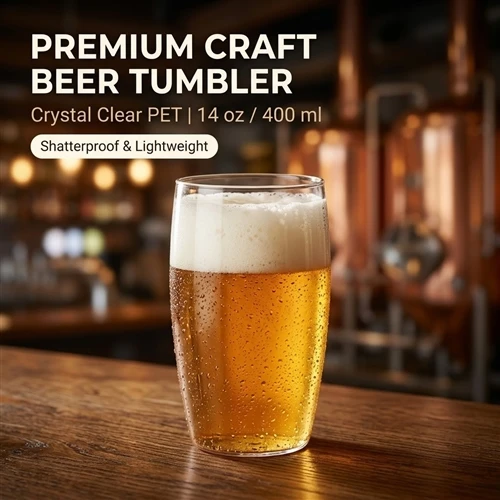
Clear plastic beer glasses for weddings and festivals are popular precisely because they preserve the visual presentation of a real glass - beer colour, carbonation, head retention - without the risk profile of actual glass.
5.2 Reduced Breakage Risk
Compared with traditional glassware, plastic drinkware designed for repeated event use is considerably easier to handle in crowded venues, cuts down on breakage-related cleanup and safety incidents, and reduces contamination risk on outdoor surfaces. That said, it's worth avoiding absolute claims here - no drinkware is "unbreakable," and durability still depends on material grade and design.
5.3 Event Logistics
For B2B buyers, the real decision drivers are practical: transport volume per pallet, stacking efficiency, expected replacement rate across a season, and how the product performs in bulk wash cycles - all factors that matter more than a single "eco" label.
6. Where Custom Plastic Beer Glasses Fit Into the New Market
As reuse becomes a stronger regulatory theme, demand for custom plastic beer glasses is growing alongside it - logo printing, private-label branding, colour customization, packaging customization and capacity/shape variation for different event formats. Long-tail demand in this space includes custom plastic beer glasses with logo, branded plastic beer cups for events, wholesale custom plastic beer glasses and private label plastic beer glasses - all pointing to the same shift: brands want drinkware that reinforces their identity across a reusable system, not just a disposable one.
7. What B2B Buyers Should Check Before Ordering Plastic Beer Glasses
- Material - PET, Tritan, SAN or PLA, depending on the specific product's durability, clarity and reuse requirements (not every material suits every application).
- Food-contact compliance - migration testing, compliance documentation and material traceability appropriate to the destination market.
- Product design - capacity, wall thickness, transparency, rim finish, stackability and how the design supports repeated cleaning and reuse.
- Customization - logo application, colour options, packaging format, mold requirements and private-label capability.
8. 2030 and the Shift From "Disposable" to "Reusable"
The regulatory direction across France and the EU broadly follows a logical progression: reduce single-use consumption → shift toward reuse → improve recyclability → move toward circular packaging design. But it's worth resisting a common oversimplification: reusable is not automatically the more sustainable choice in every scenario. Its actual environmental performance depends on the number of reuse cycles achieved, washing energy and water use, transport distances, material selection, and end-of-life recycling rates. A well-designed, well-managed reusable system tends to outperform single-use over time - but that outcome depends on execution, not just material choice.
9. What the 2030 Rules Could Mean for Beer and Event Drinkware
- Event organizers - need reusable-cup logistics: collection points, washing capacity and inventory tracking across event cycles.
- Beverage brands - need branded drinkware that supports repeated use without compromising customer experience.
- Importers and distributors - need stronger supplier qualification, material documentation and traceability as packaging compliance scrutiny increases.
- Manufacturers - need to invest in material selection, reusable product lines, testing and customization capability ahead of tighter 2030 requirements.
10. How Manufacturers Can Prepare for the 2030 Market
Develop and expand reusable product lines rather than relying solely on disposable formats.
Strengthen material traceability and documentation practices.
Prepare food-contact compliance records ahead of buyer requests.
Offer flexible custom branding - logo, colour, packaging - without long lead times.
Improve packaging efficiency to align with EU space-minimization requirements.
Support a range of event applications, from festivals to weddings to stadium catering.
11. Disposable vs Reusable Plastic Beer Glasses
| Feature | Disposable Plastic Beer Glass | Reusable Plastic Beer Glass |
|---|---|---|
| Intended use | One-time use | Multiple uses |
| Event application | Common | Common |
| Branding | Possible | Possible |
| Collection | Usually waste stream | Collection for reuse |
| Washing | Not designed for it | Built around repeated washing |
| Long-term inventory | Limited | Well suited |
| Customization | Available | Available |
| 2030 regulatory relevance | Facing tighter single-use restrictions | Aligned with rising reuse targets |
12. FAQ: Plastic Beer Glasses and the 2030 Rules
Q1. Will all plastic beer glasses be banned by 2030?
No. Both the EU's Single-Use Plastics framework and France's own cup regulation target single-use plastic products and specific packaging formats - not reusable drinkware as a category.
Q2. Are reusable plastic beer glasses allowed in Europe?
Generally yes, subject to food-contact compliance and the specific national or EU rules that apply to the product and its intended use.
Q3. What is a reusable plastic beer glass?
A cup engineered for repeated use - durable material, wash-safe construction - rather than a single serving cycle.
Q4. Are clear plastic beer glasses suitable for weddings and festivals?
Yes - they combine a glass-like appearance with easier handling, lower breakage risk and suitability for bulk event supply.
Q5. Can plastic beer glasses be customized with logos?
Yes, including logo printing, colour options, packaging customization and private-label programs.
Q6. What materials can be used for custom plastic beer glasses?
Common options include PET, Tritan, SAN and PLA, selected based on the specific product's durability and clarity requirements.
Q7. Are reusable plastic beer glasses recyclable?
It depends on the material, local recycling infrastructure and product design - this can't be guaranteed uniformly across all products. The PPWR's recyclability grading system, which starts applying from 2030, will make this easier to verify at a product level.
Q8. What should European buyers check before importing plastic beer glasses?
Material specification, food-contact compliance, testing documentation, traceability and labelling requirements.
Q9. Is 2030 the same deadline in every European country?
No. EU-level PPWR requirements and national measures - like France's postponed cup rule - run on related but distinct timelines, and individual countries can layer on additional requirements. The 2026 Commission guidance addresses exactly this kind of national-vs-EU interaction.
Q10. What should businesses do before 2030?
Start reviewing product materials, reuse models, compliance documentation and supplier capabilities well ahead of the deadlines, since several PPWR obligations phase in gradually between 2026 and 2030.
13. Conclusion: 2030 Is a Transition Point, Not a Simple Plastic Ban
The clearest way to frame 2030 for a B2B audience isn't "plastic cups get banned" - it's that Europe is shifting from reducing single-use packaging toward increasing reuse, improving recyclability, and making packaging design more circular overall, as set out in the Packaging and Packaging Waste Regulation and reflected in France's own cup-specific timeline. Within that shift, reusable plastic beer glasses, custom plastic beer glasses, and clear plastic beer glasses for weddings and festivals aren't legacy products under threat - they're the category the market is actively moving toward.
Sources cited above:
European Commission - Packaging and Packaging Waste
European Commission - New packaging rules for less waste and easier recycling
EUR-Lex - Regulation (EU) 2025/40
European Commission - 2026 Guidance document on the PPWR
European Commission - Single-Use Plastics
French Ministry for Ecological Transition - Report de l'échéance d'interdiction des gobelets en plastique à usage unique
Want this as a downloadable Word or Markdown file?