
PP, Tritan, PPSU, PC, and PET: Which Plastic Is Best for Heat Resistance and Reusable Beer Glasses?
Choosing the right plastic material is important for household drinkware, reusable cups, and commercial beverage service. Different plastics offer different combinations of heat resistance, transparency, impact resistance, cost, and service life. Understanding these differences helps consumers make informed choices and helps B2B buyers select products that match their intended applications.
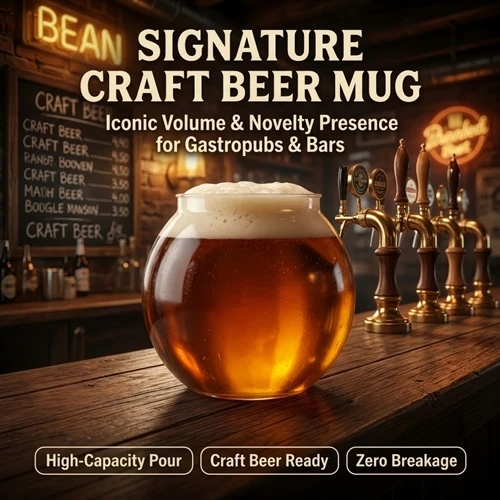
For buyers sourcing fish tank style plastic beer glass designs, the material decision is especially important. These oversized, aquarium-inspired cups are popular for parties, bars, sporting events, and promotional merchandise. Their large capacity and transparent appearance make them visually appealing, but the selected plastic must also suit the beverage temperature, cleaning method, and frequency of use.
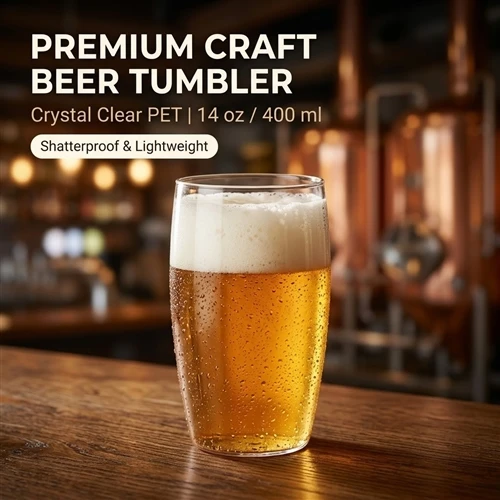
The same considerations apply to clear plastic beer glasses and reusable plastic beer glasses. A cup that looks like glass is not necessarily designed for hot liquids, microwave heating, or repeated dishwasher cycles. The safest approach is to evaluate the actual material grade and finished product specifications rather than relying on appearance alone.
1. PP: A Practical Choice for Everyday Household Use
Polypropylene (PP), commonly identified by recycling code 5, is widely used in food containers, kitchenware, and reusable drinkware. It offers a practical balance of affordability, toughness, and heat resistance.
Key advantages of PP
- BPA-free material: PP is not manufactured using bisphenol A as its base polymer.
- Good heat resistance: Many PP products are designed for hot food or beverage applications, although their permitted temperature depends on the formulation and finished product.
- Cost-effective: PP is suitable for applications where price competitiveness and high-volume production matter.
- Lightweight and durable: It is useful for everyday containers and products that need to withstand regular handling.
PP is generally opaque or translucent rather than crystal clear, so it may not be the first choice when a premium transparent appearance is essential.
Is PP the only plastic suitable for microwaves?
No. Although PP is commonly used in microwave-safe food containers, it is not the only plastic that can be approved for microwave applications. The finished container must be specifically designed and labelled for microwave use. Material type alone does not establish microwave safety.
The Singapore Food Agency advises consumers to use only plastic containers labelled microwave-safe for reheating. This illustrates why product-specific instructions matter more than a general material temperature rating.
For businesses sourcing reusable cups, PP may be suitable for selected everyday applications, but buyers should verify whether the product is intended for hot drinks, cold drinks, or both.
2. Tritan: A Transparent Material for Premium Drinkware
Tritan is a copolyester developed by Eastman. It is widely used in reusable water bottles, food containers, and transparent consumer products because it combines clarity with impact resistance.
Why choose Tritan?
- Clear appearance: Tritan can provide a glass-like look without the fragility associated with glass.
- BPA-free composition: Eastman states that Tritan is made without BPA, BPS, or other bisphenol compounds.
- Impact and shatter resistance: It can be suitable for products that need to withstand everyday handling.
- Reusable applications: Appropriate grades can support repeated use when the finished product is designed and maintained accordingly.
For buyers seeking clear plastic beer glasses, Tritan may be worth considering when transparency, durability, and a more premium product presentation are priorities.
It can also be relevant to a fish tank style plastic beer glass intended for parties, themed promotions, and beverage presentation. However, buyers should check the product's wall thickness, dimensions, capacity, and resistance to the intended cleaning process.
Can Tritan hold boiling water?
Do not assume that every Tritan product can safely hold boiling water simply because the resin has good heat resistance. Eastman's technical documentation states that certain Tritan copolyesters are cleared for specified food-contact applications at temperatures up to 100°C (212°F). The suitability of a finished product still depends on its design, food type, and intended conditions of use.
A temperature limit for a resin is not automatically a recommendation for every finished cup. Always follow the manufacturer's instructions.
For cold beer, soft drinks, iced tea, and other chilled beverages, Tritan's transparency and impact resistance may offer useful benefits. For hot drinks, dishwasher use, or microwave heating, confirm the exact product specifications before purchase.
3. PPSU: High Heat Resistance for Demanding Applications
Polyphenylsulfone (PPSU) is a high-performance engineering plastic used in demanding applications, including certain medical devices, infant-feeding products, and food-contact equipment.
Main advantages of PPSU
- High heat resistance: Certain grades can withstand service temperatures around 180°C under specified conditions.
- Resistance to repeated steam sterilisation: Appropriate grades are used in products that require demanding cleaning or sterilisation cycles.
- Strong impact resistance: PPSU offers excellent toughness compared with many conventional plastics.
- Long-term durability: Its resistance to heat, water, and many cleaning chemicals makes it useful in selected demanding applications.
PPSU often has a natural amber or honey-coloured appearance. This can distinguish it from crystal-clear drinkware, although appearance varies by grade and product design.
Is PPSU the best material for every buyer?
Not necessarily. PPSU is typically more expensive than commodity plastics, and its high-temperature performance may exceed the requirements of ordinary cold-beverage cups.
For a buyer purchasing reusable plastic beer glasses for festivals, restaurants, catering services, or promotional events, the extra material cost may not deliver a meaningful commercial advantage if the cups will only be used for cold beverages.
PPSU is worth evaluating when heat resistance, repeated sterilisation, and long service life are essential. However, a product intended for medical use is not automatically approved for every food-contact application. Buyers must verify the relevant food-contact compliance and instructions for the finished product.
4. PC: Why Buyers Should Check BPA and Product Specifications
Polycarbonate (PC) is a transparent, tough plastic historically used in water bottles, food containers, and other durable products. Some polycarbonate formulations are made using BPA, which has raised questions about potential exposure under certain conditions.
However, it is inaccurate to conclude that every PC product will release harmful amounts of BPA during normal use. Exposure depends on the material, manufacturing process, food-contact conditions, temperature, and other factors.
For buyers prioritising BPA-free products, it is sensible to request clear material declarations and supporting compliance documents rather than relying on broad marketing claims.
When sourcing clear plastic beer glasses, compare the manufacturer's material specifications, applicable food-contact documentation, and recommended use conditions. A transparent finish by itself does not tell you whether a cup contains BPA or whether it is suitable for repeated use.
For many applications, BPA-free alternatives such as appropriate Tritan grades may offer an attractive combination of transparency and impact resistance.
5. PET: Transparent and Cost-Effective, but Check Reuse Limitations
Polyethylene terephthalate (PET), commonly identified by recycling code 1, is widely used for beverage bottles, packaging, and disposable drinkware.
Advantages of PET
- High transparency for beverage presentation.
- Lightweight construction.
- Good suitability for many cold-drink applications.
- Cost-effective production for high-volume orders.
PET is often a practical option for disposable cups and selected reusable products designed for specific conditions. However, ordinary single-use PET beverage bottles should not be treated as durable, heat-resistant reusable drinkware.
Hong Kong's Centre for Food Safety notes that disposable PET bottles may deform when exposed to hot beverages above approximately 70°C and recommends against using them for hot drinks. It also highlights the importance of hygiene, avoiding damaged containers, and following intended-use conditions.
This does not mean every PET product has the same temperature limit. The performance of a finished PET cup depends on its design, material specification, and intended use.
Can PET cups be reused?
Only if the finished product is designed and labelled for repeated use. A single-use PET bottle or cup should not automatically be repurposed as a long-term drinking container.
For buyers considering reusable plastic beer glasses, ask the manufacturer whether the specific PET cup is intended for repeated use, how it should be washed, and whether any dishwasher restrictions apply.
For a fish tank style plastic beer glass used at an event, PET may be appropriate when the product is intended for cold beverages and the purchasing specification matches its actual use. If long-term reuse is required, compare the complete product specifications against those of suitable Tritan or other reusable-grade alternatives.
6. Which Plastic Should You Choose?
The best material depends on what the cup needs to do, not simply which plastic has the highest temperature rating.
| Material | Main advantage | Important limitation | Typical consideration |
|---|---|---|---|
| PP | Affordable and heat-resistant in suitable designs | Usually less transparent | Everyday food containers and selected drinkware |
| Tritan | Clear, impact-resistant, BPA-free | Product-specific temperature and cleaning limits apply | Premium transparent reusable drinkware |
| PPSU | Excellent heat and sterilisation resistance | Higher material cost; may have an amber tint | Demanding reusable applications |
| PC | Transparent and tough | Some formulations use BPA | Verify composition and food-contact documentation |
| PET | Clear, lightweight, economical | Standard disposable grades are not intended for unrestricted reuse or hot drinks | Cold-drink cups and beverage packaging |
For household use, PP is a practical choice when transparency is not essential and the product is rated for the intended temperature.
For buyers who value a clear, glass-like appearance, Tritan can be an attractive option when the selected grade and finished product meet the relevant requirements.
For demanding high-temperature applications, PPSU may be worth the additional investment. For cold drinks and cost-sensitive orders, PET may be suitable if the product's intended use is clearly defined.
No material should be selected solely because it is marketed as premium, BPA-free, or heat-resistant. Product design, compliance, and care instructions remain essential.
7. What B2B Buyers Should Check Before Ordering Plastic Beer Glasses
Choosing a material is only one part of a successful drinkware sourcing decision. Importers, wholesalers, distributors, hospitality suppliers, and promotional-product companies should also evaluate the following factors.
1. Intended beverage and temperature
Specify whether the cup will hold cold beer, iced cocktails, soft drinks, or hot beverages. Do not assume that a cold-drink cup is suitable for boiling water.
2. Reuse and washing requirements
For reusable plastic beer glasses, confirm the intended number and conditions of reuse, recommended washing method, and whether the product is dishwasher-safe. Ask for written instructions rather than relying on the generic properties of the resin.
3. Transparency and appearance
For clear plastic beer glasses, assess clarity, surface finish, colour consistency, and resistance to visible scratching under expected use conditions. For oversized or novelty designs, also review stability, grip, and the practicality of cleaning the interior.
4. Food-contact compliance
Request applicable declarations, test reports, and traceability information for the material and finished product. Requirements may vary by destination market and the type of beverage or use. A general statement such as "food-grade" is not a substitute for the appropriate supporting documents.
5. Product testing and quality control
Where relevant, ask for samples and evaluate capacity, dimensions, wall thickness, impact resistance, cleaning performance, and appearance consistency. Test the actual finished product under the intended conditions before approving large-volume production.
6. Total purchasing cost
Compare material cost, product weight, packaging, transport, expected service life, replacement rates, and order quantity. A cheaper disposable cup and a more expensive reusable cup serve different purchasing needs, so unit price alone may not provide a meaningful comparison.
For a fish tank style plastic beer glass, the right choice depends on whether the priority is low-cost event distribution, premium presentation, or repeated commercial use. Defining that priority before requesting quotations makes supplier comparisons more accurate.
Conclusion
PP, Tritan, PPSU, PC, and PET each serve different purposes. PP is a practical option for suitable everyday applications, Tritan offers an appealing balance of clarity and impact resistance, and PPSU is designed for more demanding heat and sterilisation conditions. PC requires careful attention to its composition and intended use, while standard disposable PET products should not be assumed to be suitable for hot liquids or long-term reuse.
For businesses sourcing fish tank style plastic beer glass products, clear plastic beer glasses, or reusable plastic beer glasses, the most effective approach is to start with the intended beverage, temperature, cleaning process, and expected service life. Then verify the finished product's material specifications, food-contact compliance, and care instructions.
A well-matched material can help buyers balance appearance, durability, cost, and customer expectations without paying for performance they do not need.
Frequently Asked Questions
1. Which plastic is best for everyday use?
PP is a practical, economical choice for many everyday applications when the finished product is rated for the intended use. Tritan may be preferable when a clear appearance is important, while PPSU is suited to more demanding high-temperature applications.
2. Are clear plastic beer glasses safe for hot drinks?
Not all of them. Safety depends on the exact plastic grade, finished product design, and manufacturer's temperature instructions. A cup intended for cold beer should not be used for boiling water unless the manufacturer explicitly confirms its suitability.
3. Can reusable plastic beer glasses go in the dishwasher?
Some can, but not all. Check the manufacturer's instructions for the specific product and material. Do not assume that every PET, PP, or Tritan cup has the same dishwasher rating.
4. Is PET suitable for a fish tank style plastic beer glass?
PET can be suitable for certain cold-beverage designs, including some novelty cups. However, buyers should confirm whether the specific product is intended for single use or repeated use and follow its temperature and cleaning restrictions.
5. What should wholesalers ask a plastic beer glass manufacturer?
Ask for the material specification, product dimensions and capacity, intended-use instructions, applicable food-contact documents, sample availability, minimum order quantity, packaging options, and production lead time. These details help buyers compare suppliers on more than appearance and unit price.